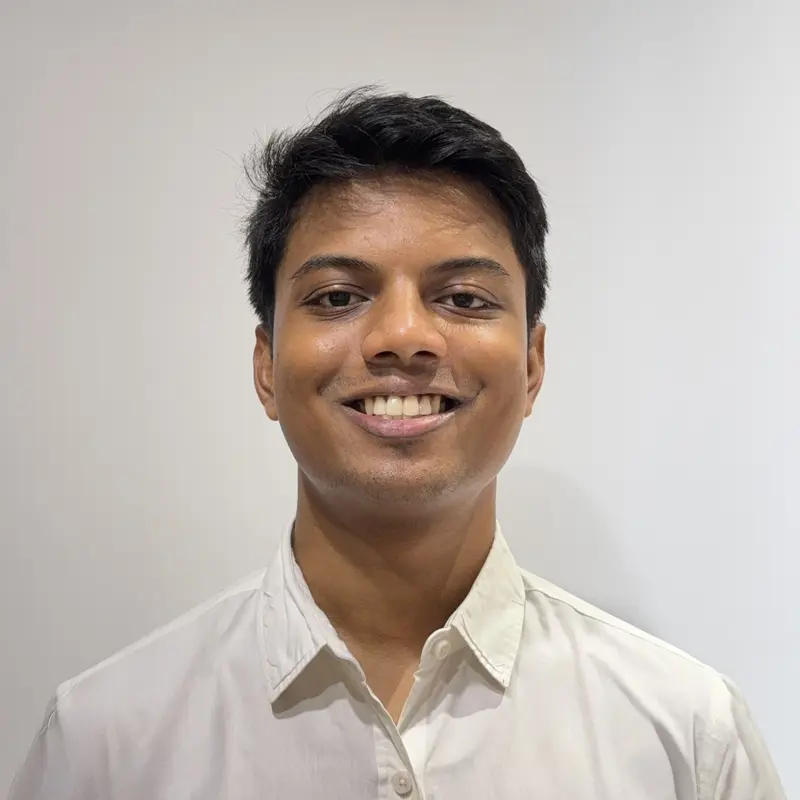
I’m a backend software engineer focused on building reliable, scalable systems with Go, Python, Kubernetes, and distributed systems. I enjoy working close to infrastructure, designing APIs, orchestration platforms, storage systems, and data pipelines that solve real-world problems.

I’m particularly interested in distributed systems, cloud infrastructure, authorization, and space-data platforms. Outside work, I build systems from scratch, contribute to open source, and write about the engineering concepts I’m learning.

Lately, I’ve been slowly diving into applied AI, exploring how LLMs and agents can be built into real products, and bringing the same focus on reliability and scale to the systems around them.

TechLanguages, tools, and infrastructure I work with

Languages & Frameworks

GoLang
GORM, Concurrency Patterns, Echo, gRPC, Gorilla Mux
Python
FastAPI, REST APIs
FastAPI
JWT Auth, Pydantic, Async Endpoints

Infrastructure

Docker
Docker Compose, Containerization, Container Networking
Kubernetes
CKA, Helm Charts, Ingress, RBAC
Argo Workflows
Workflow Templates, DAGs, Container Orchestration
Google Cloud Platform
GKE

Databases

PostgreSQL
Transactions, Indexing, Joins
MongoDB
Transactions
InfluxDB
Flux Query Language, Data Retention, Backups

Identity & Access

Keycloak
OIDC, Realm Management, Access Control, Magic Link Login
Experience3 backend roles since 2023

Geminus Space

October 2025 - Present

Founding Software Engineer (Backend)

Unified Ground Ops Platform

  • Architected and built a multi-tenant platform supporting multiple satellites and ground stations, enabling end-to-end downstream data processing workflows—from pass schedule ingestion and event-driven pipeline instantiation, through registry-based data acquisition, configurable processing chains, and long-term archival systems—using microservices in Go.
  • Designed and implemented a reconciliation engine with concurrent control loops managing data pipeline lifecycles, orchestrating multi-stage Argo Workflows with dynamic workflow generation, artifact chaining across L0/L1/L2 stages, and MinIO-backed object storage.
  • Developed a binary TCP protocol client for SAFRAN CORTEX HDR, supporting chunked streaming downloads (∼1500 blocks/request) and complex state machines for session discovery, file listing, and telemetry block reconstruction, with Python-based mock servers for development and testing.

Unified Data Platform

  • Developed a Python-based catalog importer to ingest satellite imagery from ISRO's Bhoonidhi platform.
  • Integrated commercial SAR imagery from Umbra Space, building ingestion pipelines backed by AWS S3 public catalogs with support for GEC, SICD, and SIDD (NITF) data formats.
  • Implemented ingestion support for Planet Labs SkySat and Tanager catalogs, including recursive traversal of hierarchical catalog structures specific to Planet Labs datasets.

Geminus Tech

June 2024 - September 2025

Software Engineer (Backend)

Antaris

  • Integrated multiple internal services within the Antaris Cloud Platform, enabling reliable cross-service communication and improving overall platform orchestration.
  • Worked extensively on the Mission Orchestrator, contributing to task scheduling and optimization for satellite operations by factoring in satellite constraints and imaging order priorities.

Pyro

  • Implemented Keycloak-based authentication, API key management, and multitenancy, enabling secure tenant isolation and scalable access control.
  • Designed and built backend infrastructure primitives including organization-scoped data isolation, role-based authorization, and resilient API layers to support distributed services.

Diamanti

October 2023 - June 2024

SDE Intern (Backend)

  • Resolved 2 critical Kubernetes RBAC vulnerabilities in Ultimate Enterprise and Ultima Accelerator, strengthening least-privilege access and improving cluster security.
  • Contributed to KubeVirt integration within Diamanti's Kubernetes-native platform, testing and validating ∼30 VM pods per cluster across multiple clusters to support VM-based workloads and hybrid container–VM deployments.
EducationDegrees and grades

Savitribai Phule Pune University

Pune, India

Bachelor of Engineering - Computer Engineering

July 2020 - June 2024

CGPA: 9.02

Chhatrapati Shahu Vidyalaya & Jr. College

Kolhapur, India

Higher Secondary Certificate

July 2018 - March 2020

Percentage: 80%

Dr. D. Y. Patil's Academy Shantiniketan

Kolhapur, India

Secondary School Certificate

March 2018

Percentage: 95%

Open source7 pull requests and 4 issues across 4 projects
ProjectsThings built outside work, from my own ideas to paper implementations

picseek

Go · Python · gRPC · Protocol Buffers · SQLite FTS5 · ONNX Runtime · PaddleOCR · CLIP · Sentence Embeddings · Docker · systemd

A local screenshot search engine - find any screenshot by the words in it, even when the OCR misread them, by what it means, or by what it looks like, all offline on a laptop.

+ details
  • Four-layer hybrid search - exact text (SQLite FTS5 trigrams, so partial words match), OCR-aware near matches, meaning (MiniLM text vectors) and visual (CLIP), ranked in tiers with reciprocal rank fusion and a `--why` flag that explains every hit
  • OCR-error-aware matching - folds the confusions OCR actually makes (0/O, 1/l, rn/m), collapses inserted characters and rejoins split words with a stopword guard; near hits always rank below exact ones and the stored text is never rewritten
  • Zero-shot classification into 7 types (money, travel, message, dev, security, document, chart) from vectors already stored for search, with an explicit "none of these" class - accuracy 0.70 -> 0.95, no training and no extra model calls
  • Measured search quality - a deterministic synthetic benchmark (43 rendered screenshots, 35 labelled and 4 off-topic queries) scoring recall@k and MRR per layer: 1.00 on keyword, partial and misread queries, 0.90 recall@10 overall, and no results for off-topic queries
  • Go + Python services - a Go daemon owns state and scheduling, Python services run OCR (PP-OCRv6 on ONNX Runtime) and embeddings, over typed gRPC contracts on Unix sockets, with CI checks for breaking changes and generated-code drift
  • Crash-safe indexing pipeline - a persistent SQLite job queue with leases, live and backfill lanes, retries with backoff, parking of bad files, per-worker circuit breakers, and content-hash dedup so moved or copied files are never reprocessed
  • Saved to searchable in under a second - a filesystem watcher, a live lane ahead of the backfill and opportunistic batched commits, while meaning and visual enrichment yield to OCR
  • Versioned derived data - OCR, normalisation, embedding and classifier versions are stored, so a model or rule change reprocesses only what it affects, automatically
  • Ships like a real tool - a CLI with tree output and clickable results, systemd user services at idle priority, distroless and slim Docker images, and govulncheck and pip-audit in CI

geotriage

Python · FastAPI · PostgreSQL · PostGIS · Docker · rasterio · MinIO · Ollama · React · MapLibre

A satellite imagery triage platform - describe a job in a sentence or draw it on a map, and it scores every matching archive image and ranks them green / yellow / red so analysts open only what matters.

+ details
  • Natural-language workflow agent - built a tool-using agent that turns plain English into valid satellite monitoring workflows, reusing the platform's own validation so a draft can never break its rules
  • Eval-driven prompt development - set targets before the first run, then scored every change on a 63-case eval set across 10 metrics, including whether the agent asks instead of guessing - 0.95 on answer kind and 1.00 on schema validity, against a 0.23 always-asks baseline
  • Local-first LLM engineering - ran the whole agent on a small open-weight model on CPU, with zero API spend and no data leaving the machine, choosing the instruct build over the reasoning default to keep CPU latency down
  • LLM tracing and eval caching - logged every model call with prompt version, tokens and latency, and cached responses so eval runs only re-ran what changed
  • Pluggable detectors and data sources as Docker images on a shared base - new analyses are registered, never coded into the platform
  • Sandboxed runs - short-lived containers with read-only filesystems, dropped privileges, resource limits, and no network for detectors
  • Storage policies per workflow - keep imagery only for the scenes that scored Alert, or maps only, or scores only; the rest is deleted after scoring
  • Disk guardrails at three points - the draft, the form and the start of every run, sizing scenes by their overlap with the area and refusing before anything is downloaded
  • Cost-aware pipeline - filters cloud cover at search time, drops dull scenes from a low-res preview, and reads bands at the coarsest usable resolution
  • Archive-agnostic bands - Sentinel-2 and Landsat mapped to common names and physical units, so one detector runs on any source
  • PostgreSQL job queue - parallel workers, retries with backoff, crash recovery, and scheduled re-runs for continuous monitoring
  • React + MapLibre analyst app and a Python SDK with a CLI to validate plugins and test them on real scenes
  • 340 tests across the platform (269) and SDK (71)

causality-bench

Python · NumPy · pandas · NetworkX · SciPy · Matplotlib · Discrete-Event Simulation

An experiment measuring Lamport vs vector clocks - a deterministic simulator records the true event order independently of both, then scores how much ordering the cheaper clock loses and what the exact one costs.

+ details
  • Independent ground truth built from program order and message send/receive, never from either clock's timestamps
  • Same execution for both clocks, so every difference comes from clock design alone
  • Every pair checked - a precomputed ancestor index makes all ~50M event pairs per run a single lookup, verified against brute-force search and NetworkX transitive closure
  • 1,320 runs over 2-128 nodes, 5 topologies, 3 delay models, 6 message rates, and 16 loss/crash settings (30 seeds each) - Lamport misorders 95%-99.9% of concurrent pairs; vector clocks cost 16.3x more per receive and N× more metadata
  • Crash-recovery modeling - nodes keep clock state through outages to preserve ordering guarantees
  • 163 tests across the clocks, causality engine, simulator, metrics, and notebooks

overpass

Python · FastAPI · Skyfield · SGP4 · Geodesy · WebSockets · React · Docker

A live "what's above this point?" view - pick a location and radius to see the aircraft in that circle and the satellites overhead, including which are visible to the naked eye right now.

+ details
  • True naked-eye visibility - above the horizon, sunlit, and against a dark enough sky, computed with Skyfield and JPL's DE421 ephemeris
  • WGS-84 geometry that handles date-line crossings, polar areas, and true-circle trimming
  • Live orbits from CelesTrak propagated with SGP4, with data age reported since predictions drift ~1 km/day
  • Upstream-friendly caching - aircraft every 5s, orbits every 2h, concurrent identical requests collapsed into one call
  • Robust OpenSky client - cached OAuth2 tokens, retry on expiry, and rate-limit waits passed back to callers
  • Graceful partial failure - sources fetched in parallel and served over REST and a live WebSocket stream
  • Flight numbers from callsigns, decoded against 136 airlines to separate commercial from private traffic
  • Layered architecture (API -> services -> clients -> domain), started with one `docker compose up`

cadutrace

Go · CCSDS · Binary Protocol Parsing · Bubble Tea · mmap

An offline analyzer for CCSDS spacecraft telemetry - unpacks raw ground-station recordings from transfer frames to reassembled packets to decoded data, producing a health report or an interactive terminal UI.

+ details
  • Packet reassembly across frames, detecting lost or truncated packets
  • Zero-copy mmap parsing - multi-GB captures are parsed in place, with only frame-spanning packets copied
  • Wrap-aware gap detection classifies missing, duplicate, and out-of-order data across counter rollover
  • CFDP file-transfer tracking down to the exact missing byte ranges, even with out-of-order or overlapping pieces
  • Standards coverage - TM/AOS frames, Space/Encapsulation packets, CLCW reports, optional derandomization
  • Isolated, pluggable decoders selected by packet ID, so one crashing decoder can't stop the analysis
  • Two interfaces - a deterministic text/JSON report for CI diffs and a Bubble Tea TUI for browsing frames, packets, hex dumps, and transfers
  • Synthetic generator for byte-exact, lossy, gigabyte-scale test recordings

walrus

Go · Write-Ahead Log · Key-Value Store · HTTP API

A single-node persistent key-value store in Go (zero dependencies), fast in-memory reads backed by a segmented write-ahead log for durability and crash recovery, with optional per-key TTL.

+ details
  • WAL-first writes - every mutation is appended and fsynced to disk before the in-memory map is updated, so acknowledged writes survive crashes
  • Segmented binary log (64MB segments) with a 21-byte header + CRC32 per record (~25 bytes fixed overhead)
  • Crash recovery by replaying segments on startup in a single O(n) pass; corrupted tail entries are detected and skipped
  • Zero-allocation reads (0 allocs/op) served directly from the in-memory map
  • Per-key TTL with two-tier eviction, lazy on read plus a background sweeper goroutine
  • Zero external dependencies, built entirely on the Go standard library; HTTP/JSON API
  • Tested and benchmarked - 26 unit tests and 6 benchmarks across the WAL, store, and HTTP layers

autorollout

Go · Kubebuilder · Kubernetes Controller · Client-Go · Docker

A CRD-free Kubernetes operator that triggers rolling restarts of Deployments when the ConfigMaps or Secrets they consume actually change.

+ details
  • Label-based opt-in (autorollout.io=true) and CRD-free - installs from a single YAML, no custom resources
  • Detects all 4 reference patterns (env valueFrom, envFrom, volume mounts, imagePullSecrets)
  • Event-filtered reconciliation - ignores Create/Delete and metadata-only updates, firing only on real data changes
  • Namespace-scoped Deployment scan rebuilds the dependency graph live from pod specs (no stored state)
  • Delegates the restart to Kubernetes' native rolling update via a pod-template annotation patch
  • Built on controller-runtime with RBAC, health probes, and an authn/authz-protected metrics server
  • End-to-end tested on a real Kubernetes (Kind) cluster - controller startup, pod health, metrics exposure, and restart-on-change

Implementations

Papers and protocols built from scratch, with my own twists

magpie

The SWIM membership protocol, in Go. On top of the paper it adds a left state, joins through seed nodes, a two-way state sync that heals network partitions, and a simulation harness to measure it all: the suspect state cut false failure detections by 98% at 10% packet loss, and probing stays at 2 messages per node per period from 10 to 1000 nodes. A React dashboard crashes, isolates and restarts nodes in a Docker cluster of any size.

otter

The Raft consensus algorithm, in Go over gRPC. Leader election, log replication with backtracking and conflict truncation, and the current-term commit rule, with each node's state persisted through an atomic temp-file and rename so a restarted node rejoins safely. It drives a replicated key-value store that keeps working with a minority of nodes down.

meerkat

Consistent hashing put to work in a distributed key-value store, in Go. A coordinator owns a CRC32 hash ring and writes every key to its owner and the next node on the ring, reads fail over to that replica, and when a node joins, leaves or stops answering health checks, its keys migrate automatically. Storage is BadgerDB behind gRPC, with Prometheus metrics.

graphauth

Zanzibar's relationship-based authorization, modelled as a graph in Go. Permissions are edges between users, groups and documents, and a check resolves nested group membership in a single bounded Neo4j traversal, up to 15 levels deep, returning allow or deny with the reason. Neo4j and an in-memory store sit behind one interface.

Smaller builds

Shorter projects and pieces that support the bigger ones

geotriage-sdk

The Python SDK for geotriage plugins - base classes for detectors and data sources, a CLI to validate them and test them against a live archive and a real scene, and the Docker base image every plugin builds on.

go-software-raid

User-space RAID 0/1/5/6 in Go, file-backed disks with block I/O through a RAID abstraction layer. RAID 5 (XOR) survives 1 disk failure and RAID 6 (Galois-field dual parity) survives 2; usable capacity 100/50/75/50%. Covered by 14 unit tests.

CoWIN-Slot-Finder

A vaccination-slot discovery web app from India's 2021 COVID drive, a React (Vite) SPA over a stateless FastAPI proxy to the public CoWIN API, with State -> District -> Center navigation and pincode search. No database, no auth; migrated from an original Django build.

Blogs32 posts, all on Medium

2026

2025

2024

2023

2022

2021

PapersPapers and what I took from them
ContactThe form goes straight to my inbox

or, directly:

© 2026 Aditya Bhalerao

source · updated